Technology

One computational engineering platform, applied beyond the core products.

The core of H₂-Enterprises is two modular LOHC energy-system families. The same engineering platform extends to waste and synthetic fuels, advanced engineering and advanced aerospace — each shown with its actual development status.

01Waste & synthetic fuels

Waste & synthetic fuels.

One technology vertical within the wider computational engineering platform — presented with its actual development status.
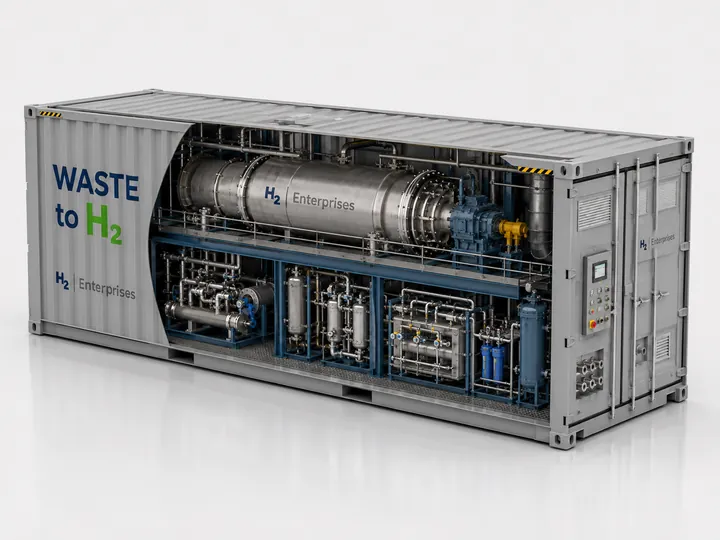
  • Rendering of a 20-foot shipping container with a cut-away side revealing a stainless-steel reactor vessel, piping and process skids, lettered “WASTE to H₂” and “H₂ Enterprises”.Concept rendering

    Waste-to-Hydrogen

    Organic and mixed waste conversion to hydrogen through modular thermochemical processing. H₂-Enterprises developed Waste-to-Hydrogen technologies, concepts and project opportunities. No commercial Waste-to-Hydrogen plant has yet been constructed because the required project financing was not secured.

    Technology & project developmentNot Constructed
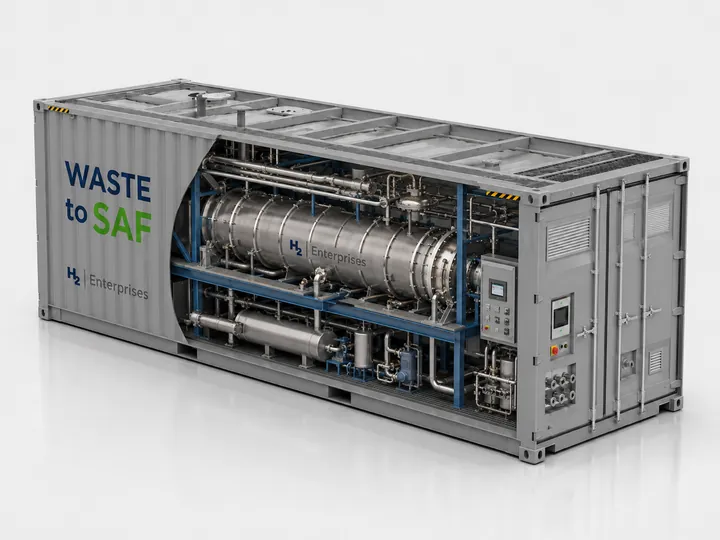
  • Rendering of a 20-foot shipping container with a cut-away side revealing a long stainless-steel reactor, piping and a control panel, lettered “WASTE to SAF” and “H₂ Enterprises”.Concept rendering

    Waste-to-SAF & eDiesel

    Waste-derived syngas followed by synthetic fuel production — potential outputs include Sustainable Aviation Fuel (SAF), eDiesel and naphtha.

    Technology development
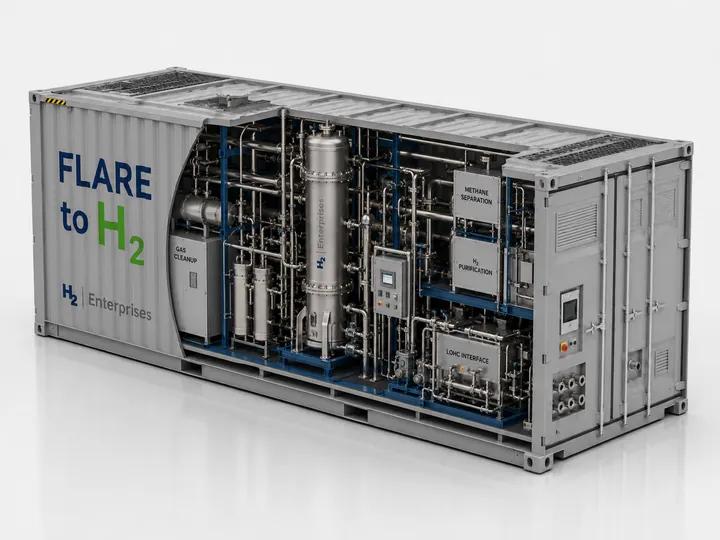
  • Rendering of a 20-foot shipping container with a cut-away side revealing a gas-cleanup unit, a stainless-steel column, methane-separation, H₂-purification and LOHC-interface modules, lettered “FLARE to H₂” and “H₂ Enterprises”.Concept rendering

    Flare-to-Hydrogen

    Conversion of flare gas and methane to hydrogen and solid carbon through pyrolysis-related pathways.

    Technology development

Waste-to-Hydrogen explanatory film

02Advanced engineering · Recuperation Jet Turbine

Recuperation Jet Turbine: an advanced engineering development.

An example of computational design applied beyond the core LOHC products: two recuperation jet-turbine architecture variants, electric and hydrogen. All images are engineering or conceptual visualizations — not a tested, certified or commercially available engine.

Two architecture variants

Engineering visualization: two recuperation jet-turbine architecture variants shown one above the other as open cutaway assemblies on a dark background.Engineering visualization · Development image
Electric and Hydrogen Recuperation Jet Turbine — design comparisonA side-by-side engineering visualization comparing the two recuperation jet-turbine architecture variants.
Conceptual flow visualization: the two recuperation jet-turbine architecture variants shown one above the other, with illustrative blue and orange flow effects.Conceptual flow visualization
Electric and Hydrogen Recuperation Jet Turbine — flow comparisonIllustrates the intended flow and energy-path concept of the two architecture variants.Flow and thermal effects shown are illustrative unless otherwise stated.

Electric Recuperation Jet Turbine

Cutaway engineering visualization of the Electric Recuperation Jet Turbine concept, with illustrative blue flow lines on a dark background.Engineering visualization · Design concept
Electric Recuperation Jet TurbineA cutaway view of the internal architecture and the major rotating and energy-conversion sections of the Electric Recuperation Jet Turbine concept.Flow and thermal effects shown are illustrative unless otherwise stated.

Hydrogen Recuperation Jet Turbine

Cutaway engineering visualization of the Hydrogen Recuperation Jet Turbine design, shown as an open assembly on a grey background.Engineering visualization · Design concept
Hydrogen Recuperation Jet Turbine DesignThe hydrogen recuperation architecture — an advanced propulsion and thermodynamic engineering development.
Conceptual visualization of the Hydrogen Recuperation Jet Turbine, with illustrative blue intake and orange thermal effects.Conceptual flow visualization
Hydrogen Recuperation Jet Turbine — flow and thermal conceptMakes the high-level energy and flow concept of the hydrogen architecture understandable. It is not evidence of a tested running engine.Flow and thermal effects shown are illustrative unless otherwise stated.

03Advanced aerospace engineering

Advanced Aerospace Engineering

Applying computational engineering, thermodynamics, fluid dynamics and materials science to high-speed propulsion architectures.

Advanced aerospace demonstrates the breadth of the computational engineering platform. It is longer-term engineering development, not the immediate commercial focus of H₂-Enterprises.

04Engineering studies

Recuperation Turbine Architecture

An engineering study exploring recuperation-turbine architecture within H₂ Enterprises’ broader energy-systems development.

Engineering render of an electric turbine architecture study in a CAD-style cutaway on a dark background.